
Wine
A story about a grape and a wine…..and a friend who passed.

I’m away from home at the moment - writing, walking, eating. I thought I’d write up about my wine making as I’ll most likely include something about wine making in my book. Please let me know if you’ve ever made wine and how it turned out. For a complete novice, I think I made a good vintage. I just wish it was a bit bigger!
Back in February I decided to make wine. This is the first year that I’ve successfully grown grapes. The one vine I had was loaded with large bunches of small red grapes. These grapes are wine grapes and so have tart skins and seeds. Some people in my family don’t like them because of those two traits. Some loved them, because the juice was actually sweet and full of flavour. I loved them because they tasted good and because I grew them! I also believe that seeds=flavour. Seedless grapes are insipid!
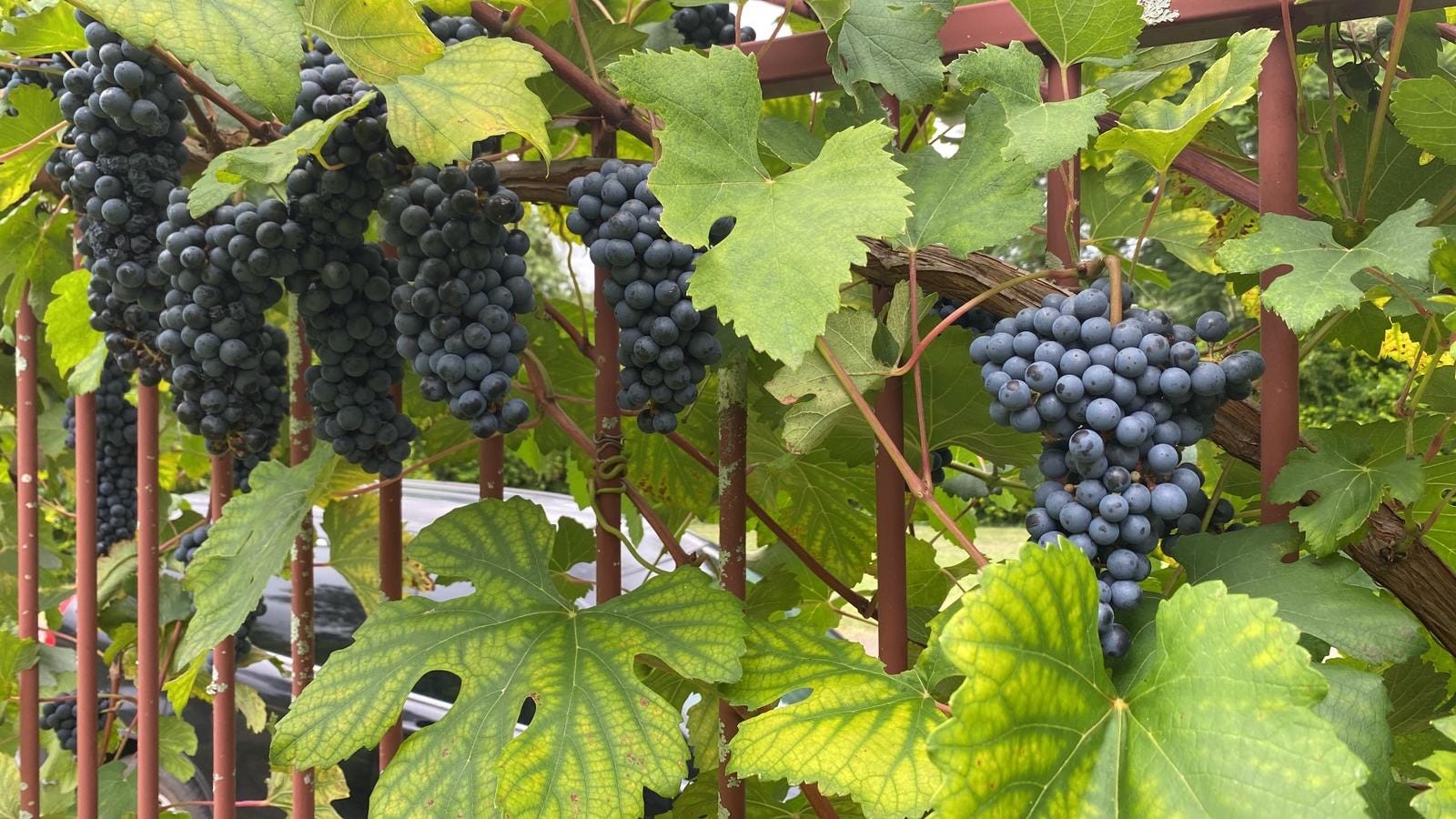
These grapes have a story…….
Years ago we had a free range pork business and I used to sell our meat at the markets in Rockhampton (and other places, but this story is about the Rockhampton markets). I’d often have a yarn with an old friend. He worked for the local distributor for Organic and Quality Foods (an organic delivery business based in Brisbane). Keith was a pretty unique character and we’d known each other for a few years.
One day when we were chatting at the markets, he told me about a friend of his who had some wine he wanted to give away. He knew I liked wine and thought that maybe I’d like some free wine. I got Brad’s number and in due course I found myself at his place collecting a box or two of red wine that he’d cellared and he thought that he’d kept them too long. He was correct. Not many of those wines were worth drinking.
However, we got talking that day and he told me about his grape vine and that he made wine from it each year. Of course this idea appealed to me more than the old wine he was giving away. In due course, he gave me some cuttings of the vine and I planted them in pots. Fast forward to when we left Anabank, I still had those plants in pots. I had never planted the cuttings out because I knew that we may not be staying there. I gave the plants to my friend Fiona and she grew them out. When we moved to Serenity, she gave me back some cuttings.
After making the wine and in preparation for writing this story, I contacted Brad to find out more about the grapes. I’d misplaced his number so I messaged Keith. No response. I rang the lady he worked for and she told me that he’d passed away! It made me sad to think that this happened without me knowing. We meet people in life and then move on, just assuming those people will still be there. As I said before, Keith was unique and he had always eaten a healthy diet, so I thought he’d live forever. Although, in saying that, he liked to eat a raw food diet and back when I saw him often, he was in the habit of eating raw meat, kind of femented, but not it a way I would think was safe, so my first thought of him dying was that he’d died of food poisoning. He didn’t, his heart just stopped working. Maybe he gave too much of his heart to others…….may he rest in peace.
Anyway, I got talking to Brad and his grape does heave a very interesting story. Brad has German heritage and the grapes have been in the family for a very long time. He got a plant from his Aunt and he is unsure if any other family members still have the same vine. His ancestors came out to Australia between 1850 and 1884. One of these or another German immigrant, brought the grape with them to the Darling Downs and Lockyer Valley region. There was a white grape, but it got lost over that time.
Brad has done quite a bit of research and this is some of what he sent me:
I tried to give it to the Wine Industry and some cuttings ended up in Stanthorpe but I do not know if any vineyard is growing it. I introduced it to O’Reilly’s Vineyard near Canungra but a flood washed them out shortly after they were planted. In July 2018 I sent some cuttings to a Vineyard in Kingaroy. I have not heard from them since.
I contacted an Ampelographer, Mr George Kerridge (a person who identifies grape varieties) to try to identify the vine. After supplying him with as much information as I could he wrote back with what he thought was the grape variety.
He believed that it is a variety called “Gamay de Bouze”. If it is, it was developed in the Loire Valley in France in 1823 by a man called Caumartin. He crossed a Gamay variety with a Tenturier Du Cher variety to produce this variety. Apparently the Tenturier Du Cher grape has coloured flesh and this grape has that anomaly. The grape is dark purple with small berries which are tightly bunched. There are large seeds in the berry. However it is quite delightful to eat when fully ripe. The fresh juice is also superb let alone the wine it produces. Mr. George Kerridge, the ampelographer, suggested that I send some samples of the vine to the Wine Research Centre in Adelaide to validate his identification. This I did but they could not find any DNA to match this vine in their records.
It is possible that the CSIRO may be of assistance in identifying this grape as I am told that they did import some Gamay De Bouze vines in the 1960’s. At this point in time I have not communicated with them on this subject. In the meantime it has been suggested by David Oag the Principal Horticulturist in the Department of Agriculture and Fisheries in Queensland to name the variety as “Gamay De Bouze-Bauer”. This name identifies it as the Bauer variety of Gamay De Bouze for the fruit and any wine made from it.
The other thought Brad (whose surname is Bauer) had was that it may have been a variety that didn’t survive the Phylloxera parasite. This almost wiped out the wine industry in Europe and the infestation lasted between 1850 and 1890. This coincides with the dates that Brads ancestors migrated to Australia, before the phylloxera parasite came from the America’s. I like this version of the story better, because it means that the grape could be even more rare!
Another story connected to Brad - one time when I was visiting, we got talking about sausages and salami. He had a sausage filler that he didn’t want any more. He gave it to us and it’s the same one we still have and use. I have many reasons to be grateful for having a friend like Keith who introduced me to Brad.
Back to the wine I made back in February. A Chilean friend was keen to help me, and she had a friend who was a wine maker back home. She talked to him and I talked to ChatGPT. We came up with virtually the same method to make the wine.
We picked all the grapes - these were very ripe and starting to dry on the bunch, which is what I was looking for. We squeezed them by hand - I wasn’t sold on the idea of stomping and didn’t really have the correct tub to do that in. First the grapes were quickly washed - quick, because you only want to wash off dust and insects and not the lovely wild yeast. We then stripped the grapes off the stalks and squashed them at the same time.
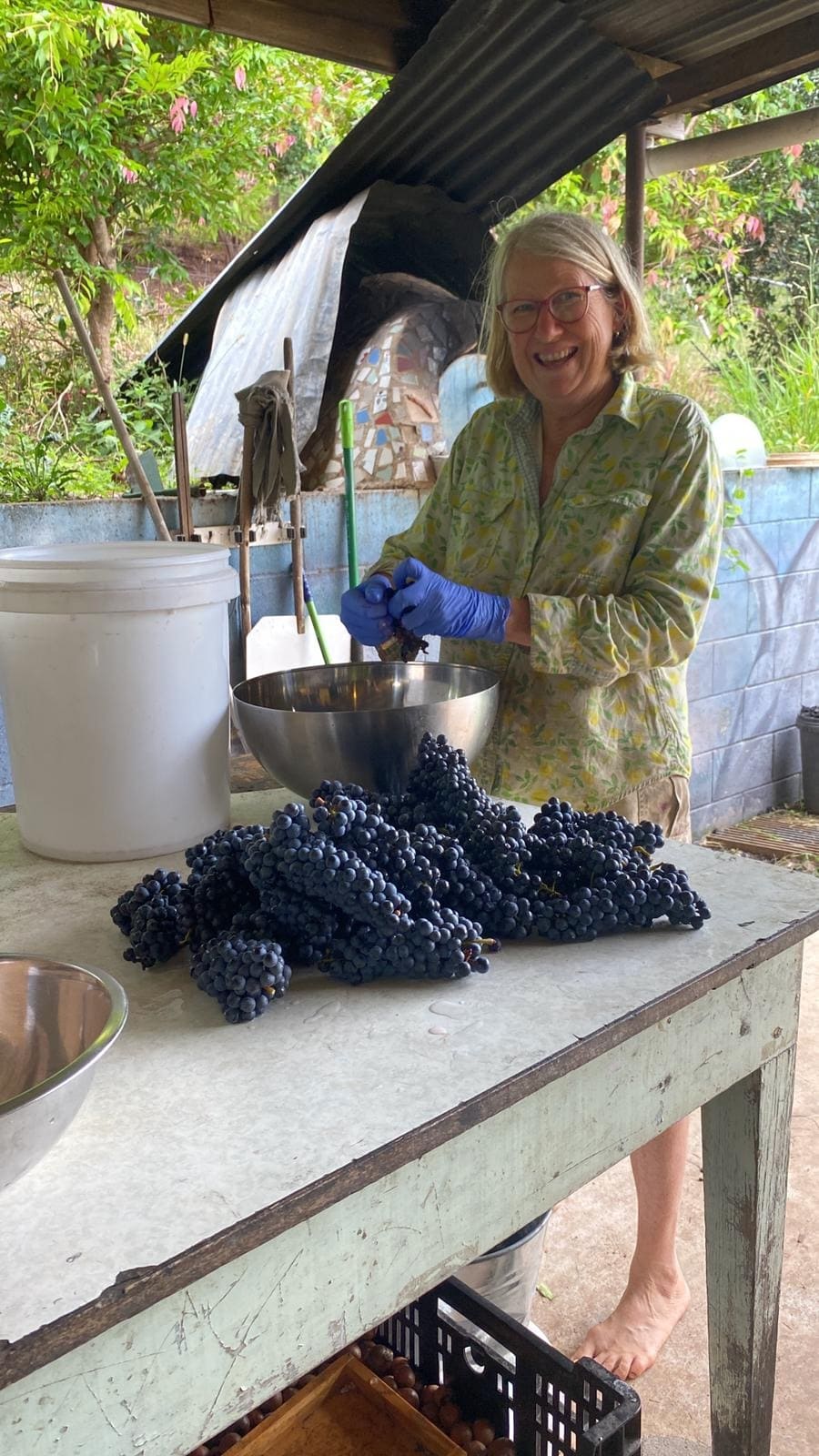
I put the pulp into a large ceramic jar I have - it was about 10 litres of juice and pulp. The Brix was measured at 22, using a refractometer. Hydrometer measured 1.1. The measurement of Brix’s gives an indication of what the wine might be like. 22-24 is ideal for a merlot style, which is what I told ChatGPT that I was looking for. 20-21 will be a lighter wine and 25+ apparently you need to watch the temperature carefully - not sure exactly what that means, but I assumed that it could risk it fermenting too much and getting to warm. If the wine seemed to be getting warm, it’s suggested to wrap wet towels around the jar to cool it down.
I then waited for wild fermentation to start. To do this I stirred it whenever I thought about it - at least twice a day. Temp was suggested to be around 22-26 C but we’re talking summer in Queensland! I did keep it as cool as I could. It smelt good, tasted sweet and then slightly tangy as it started fermenting, which started on day two.
I tested the specific gravity each day by taking a small sample of juice. The typical progression is to start around 1.1 and when SG is between 1.01 and 1 and the following is true - taste is barely sweet, skins are pale and sinking, it’s time to press. It took 7 days to reach 1.01 SG. If I wasn’t measuring and just going on taste, I probably would’ve pressed a day or two earlier.
I bought a 5 litre press and pressed once only. I had read somewhere to re-press, but that it could also make it bitter. I also had trouble pressing as I needed more wooden blocks in the press.
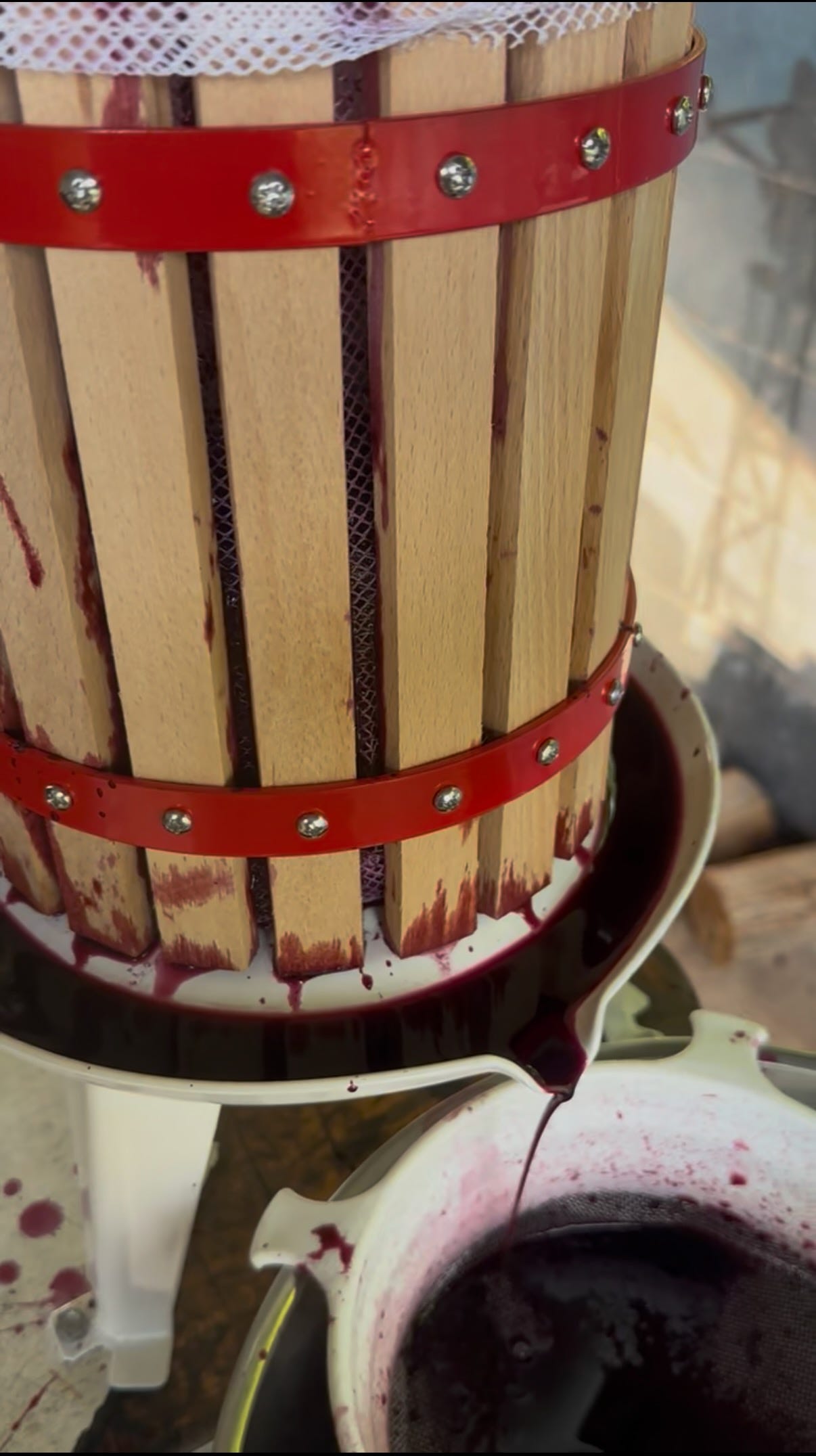
I ended up with about 7 litres in my two carboys.
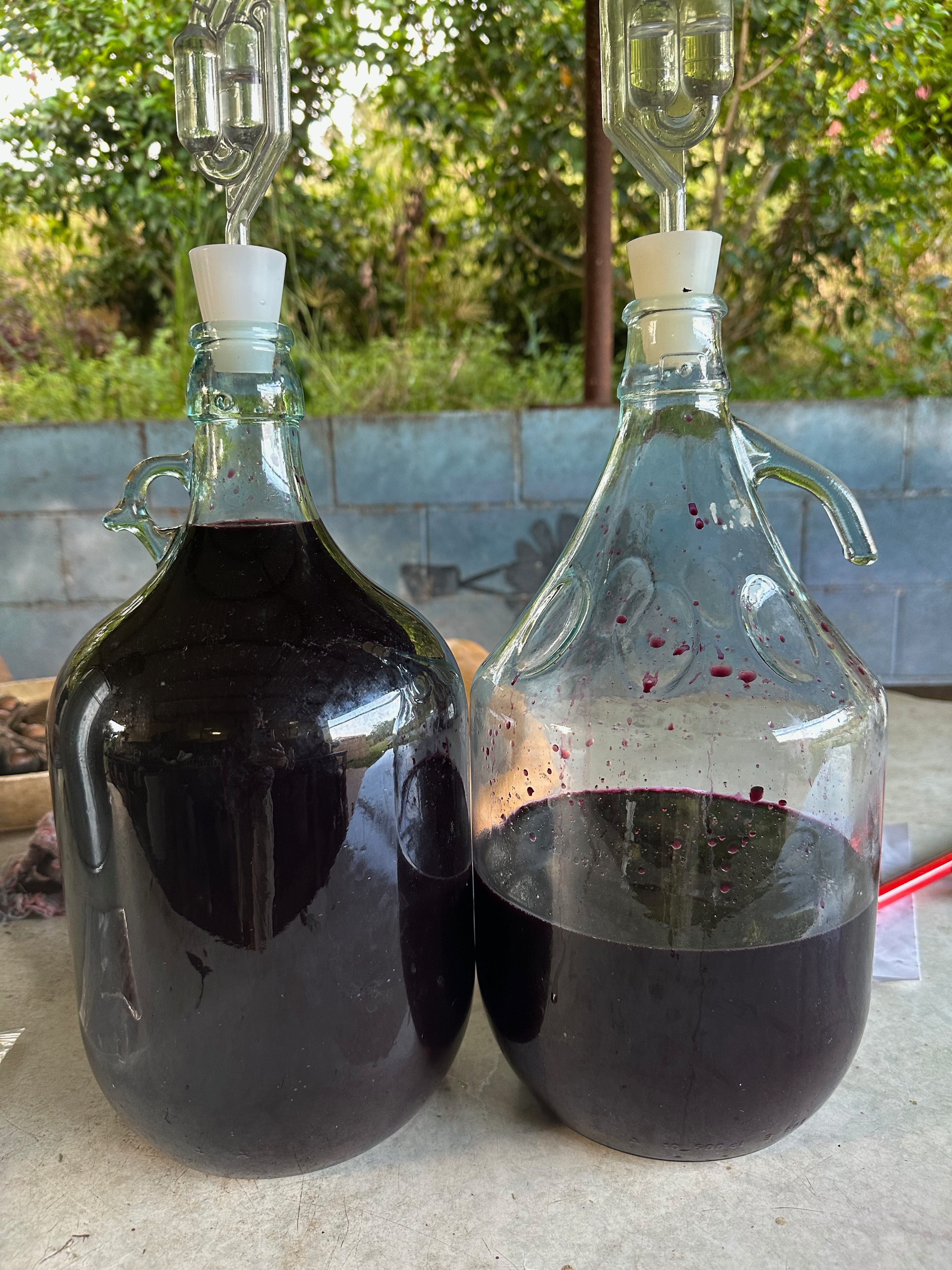
A month later, I racked the full bottle. This is when you syphon off the wine and leave the dregs in the bottom of the bottle. The bottle is then cleaned and the wine put back in and topped up from the half full bottle. The SG was just under 1000 at this stage and actually tasted pretty good! The second carboy was .995 so I put that into smaller bottles. One with an airlock on and the other wasn’t full, so I just capped it to use to refill if I racked again. This was in April.
I then went back to ChatGPT and it was suggested not to rack again unless I needed to, as with no-sulphite wine, racking and therefore adding more oxygen leads to risk of contamination and removing the yeast can slow or stall fermentation. I just had to sit and wait for it to get down to a SG of .995.
So I drank the half full bottle - very good, but a little rough still.
The small full bottle met the same fate a little while later - May
Then finally in mid June, the SG reached the required .995. Once again, if I was going on the taste or look of the fermentation, I would’ve bottle a lot sooner. The 5 litre carboy gave us just over 6 x 750 ml bottles of wine.
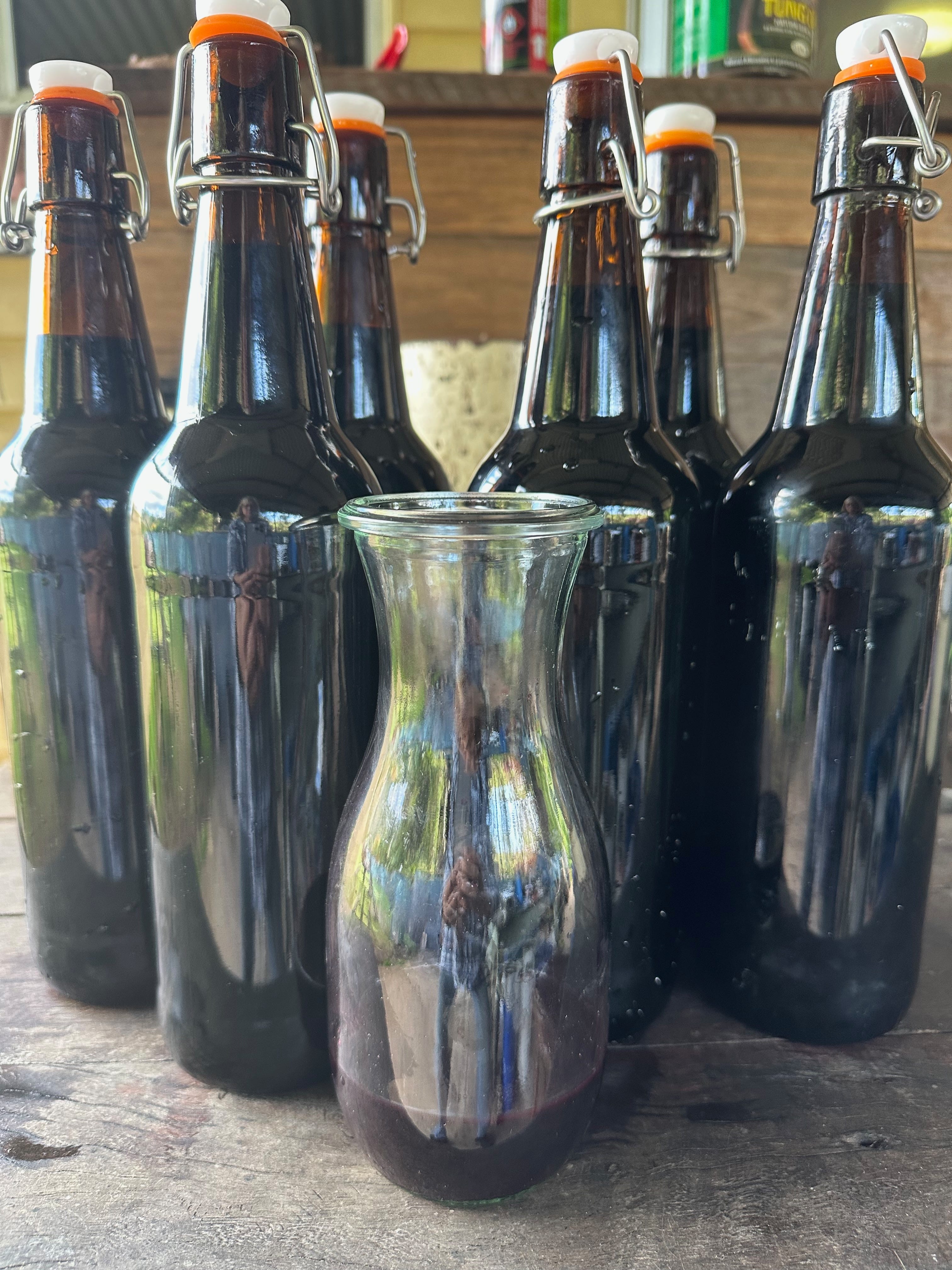
I’m now down to 5 bottles and am trying to store it as long as I possibly can. I didn’t rack in the period prior to bottling. The wine looked a good colour (not cloudy) and there didn’t appear to be a lot of sediment, although once I siphoned it out, there was a small amount of sediment.
Some other suggestions from ChatGPT:
drink within 6-12 months (that’ll be easy to achieve)
the measuring tools used and why - refractometer gives a sugar check in the beginning. During fermentation, the hydrometer is to make sure it’s alcohol safe. The final dryness test of the hydrometer (.995) is for bottling safety.
things to look out for during fermenting:
sharp vinegar smell
nail poish / solvent smell
slimy texture
mould on cap
These are all fixable if caught in time, but as I didn’t have those problems, I’m not sure how to fix them.
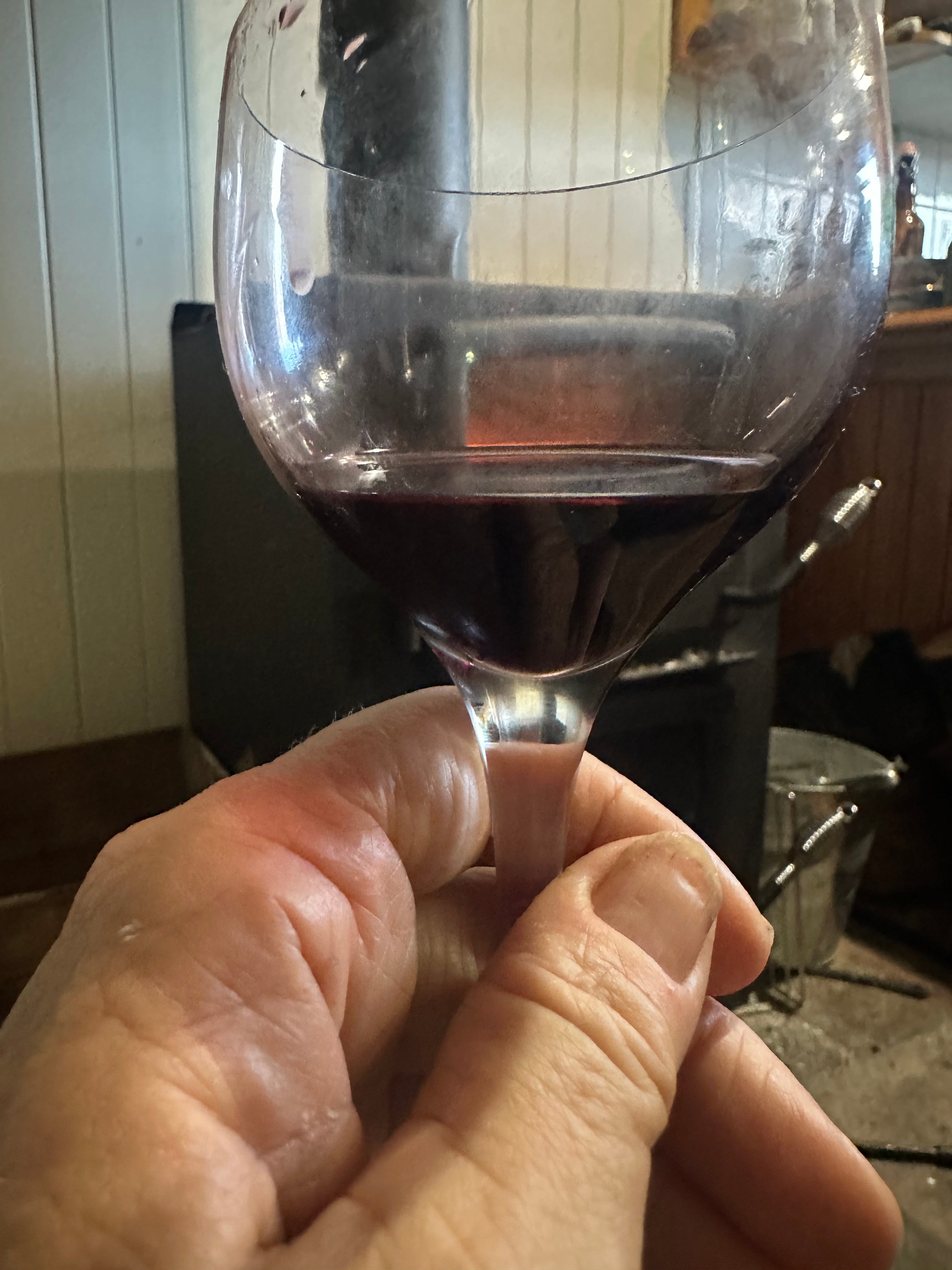
What I haven’t done, is tried to calculate the final alchol. I broke my second hydrometer after taking the last reading. I think it tastes like a mid level wine. It’s very easy to drink and I don’t drink a lot anyway, so the % isn’t really an issue for me.
I have had a very successful wine making and I’m looking forward to planting more grapes this year and maybe we’ll have more to make wine with next year. In the meantime, I’m hoping to play around with some country wines or fermented sodas.
Cheers……
Now you have me interested, I'll have to get some cuttings from you